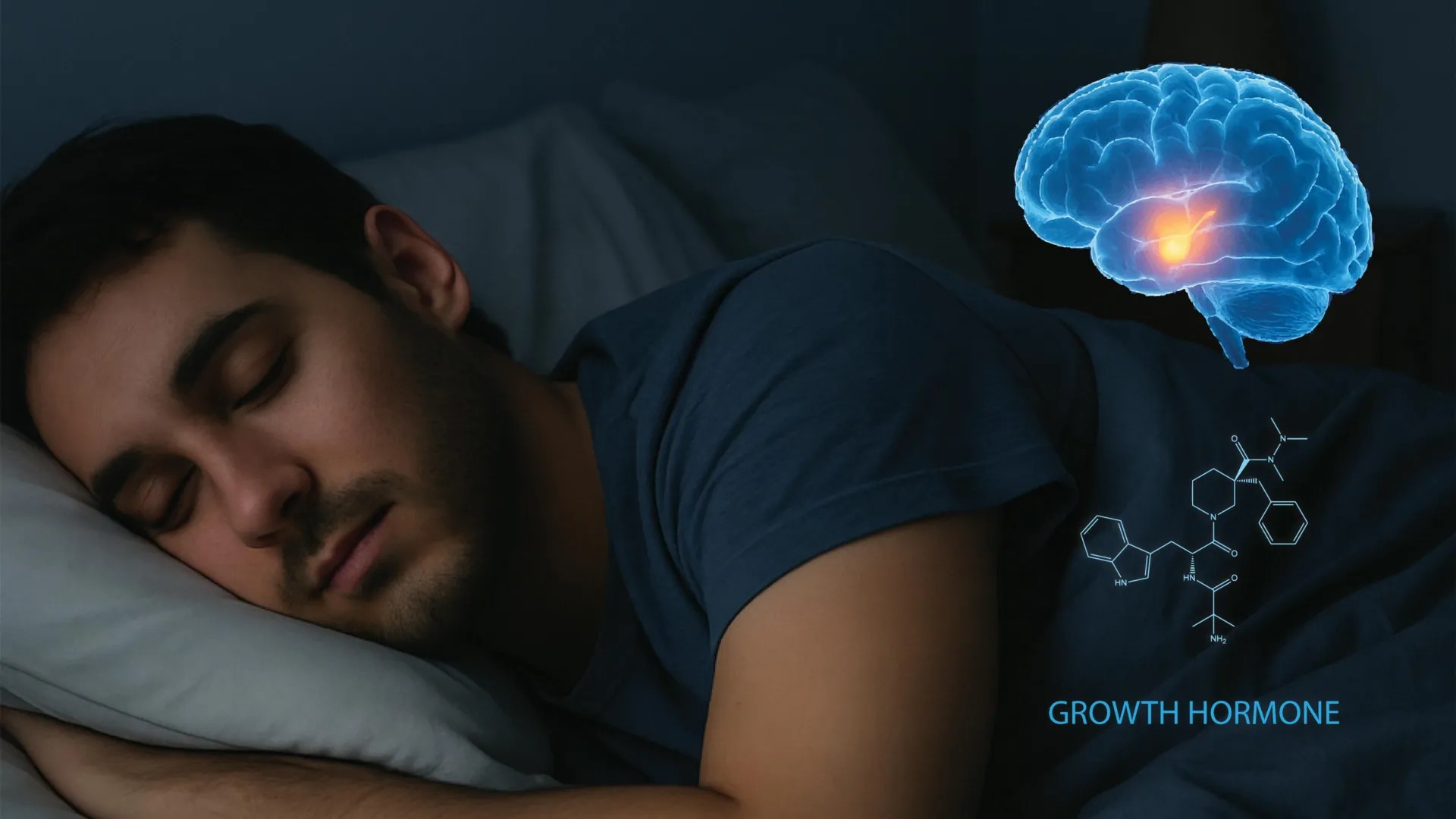
Growth hormone spikes when we sleep. Deep sleep. The kind without dreams. Everyone knew that much. Draw blood during REM and you’ll see it. The problem was never if it happened.
It was how.
Now, UC Berkeley researchers have peeled back the layers. They mapped the brain circuitry that triggers growth hormone. Published in Cell, the study reveals a hidden feedback loop keeping our hormones in check. This isn’t just basic biology.
It’s a blueprint for treating metabolic diseases. Diabetes. Obesity. Maybe even Parkinson’s and Alzheimer’s.
“People know that growth hormone release is tied to sleep,” Xinlu Ding said. She’s a postdoctoral fellow at Berkeley’s neuroscience department. “But until now, we only checked hormone levels. We’re actually watching the neurons fire. Providing a basic circuit to work from.”
Bad sleep messes up glucose. Fat metabolism. Cardiovascular risk. The connections are clear but fuzzy until now.
The Wiring of Hormone Release
Deep in the hypothalamus. That ancient brain stem region every mammal shares. The nerve cells responsible for growth hormone live there. Specifically, growth hormone-releasing hormone neurons. Plus two types of somatostatin cells.
Here’s the twist. Once that hormone is out in the body, it talks to the locus coeruleus in the brainstem. The part of the brain that handles alertness. Attention. Processing new information.
Trouble there links to psychiatric disorders. Neurological decay.
Daniel Silverman, a co-author and fellow postdoc, sees potential here. Experimental gene therapies already target specific cells. Why not dial back the excitability of that locus coeruleus? Nobody’s tried that handle before.
Mapping the Burst
Professor Yang Dan’s lab put electrodes in mice. Zapped hypothalamic neurons with light. Recorded the sparks.
Mice sleep in short bursts. Minutes long. Perfect for observing cycles. Over and over. The team watched growth hormone activity change as the animals drifted between sleep and wakefulness.
Two peptides run the show.
- GHRH : Promotes growth hormone.
- Somatostatin : Suppresses it.
They behave differently depending on where the sleep stage lies.
During REM, both peptides rise. Growth hormone flows freely.
During non-REM deep sleep? Somatostatin drops. GHRH ticks up moderately. The balance shifts.
The Loop That Breaks Open
Here’s what nobody expected.
As growth hormone builds up during sleep, it hits the locus coeruleus. Stimulating wakefulness. But push it too hard. Activate the locus coeruleus too much. Suddenly. It promotes sleepiness instead.
A feedback loop. A check on itself.
“Too little sleep reduces growth hormone. Too much hormone pushes the brain toward wakefulness.”
Silverman put it bluntly. Sleep drives the hormone. The hormone regulates wakefulness. Essential for repair. For metabolism. For staying alive.
And cognition? Growth hormone might help your arousal level the moment you open your eyes. Not just building muscle or burning fat.
“It promotes overall arousal.” Ding said. “Cognitive benefits. Right from the start of the day.”
Funded by Howard Hughes Medical Institute. Dan was an investigator there until this year. Also Pivotal Life Sciences.
A long list of authors backed it. From UC Berkeley. From Stanford. Fuu-Jiun Hwang. Jun Ding. The work is done.
The circuit is found.
Now. Do we have the courage to tinker with it. To turn the knob on sleepiness before breakfast. We have the wiring diagram. The rest is just engineering. And luck.
Most of us will keep burning the midnight oil. Ignoring the signal.