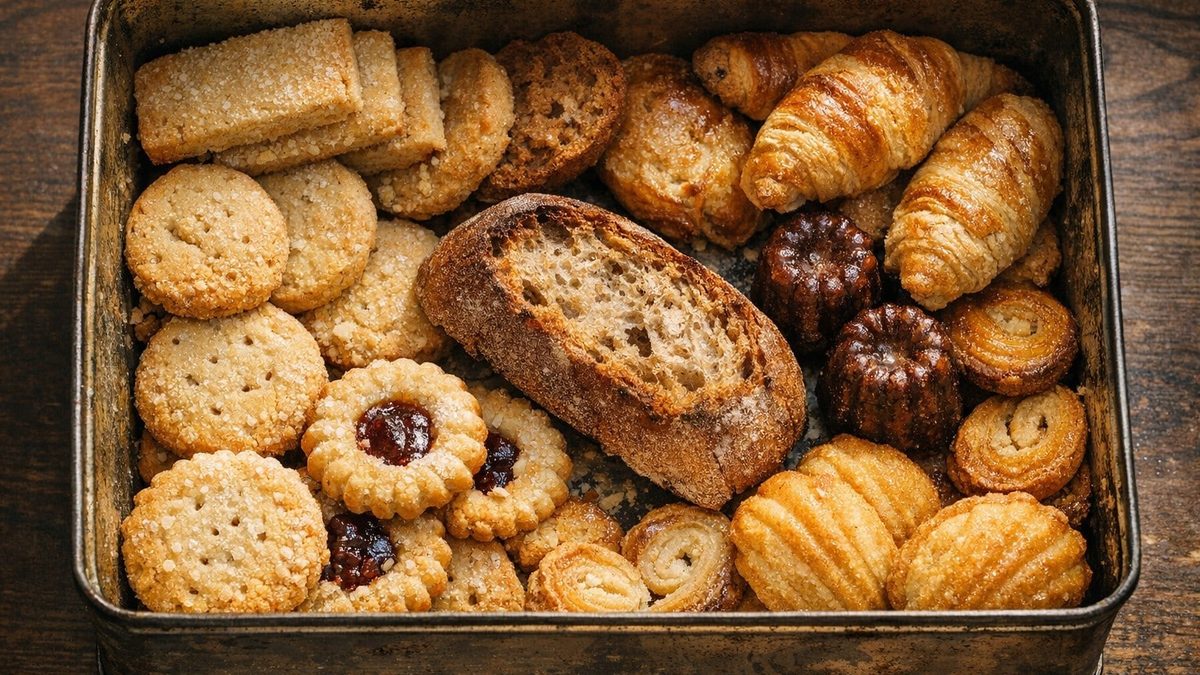
You saw it. That old metal can in the sideboard. It’s filled with homemade shortbread, maybe some canestrelli or a Breton galette. But lurking in the corner, often overlooked, is the crust of stale bread. Or sometimes just two sugar cubes.
Our grandmothers did this without explanation. We copied them. We thought it was weird. Now food science finally gives us the vocabulary to understand what happened in that box. It wasn’t magic. It was physics.
The enemy is the surrounding air
The problem starts with a simple physical fact: Cookies are dry.
Their structure consists of starch and sugar networks that have been dried during baking. This low moisture content makes them hygroscopic. It’s a fancy word “naturally drawn to water”. The cookie is programmed to absorb the moisture floating around it.
When these cookie molecules trap water vapor from the air, the sugars dissolve easily. The starch becomes softer. The stiff, crunchy texture disappears.
This is how the crunchy shortbread in the morning turns into a tough rubber the next day. Even in the best container, moist air gets in every time you open the lid. It feels like you’re fighting a losing battle.
Unless you add something even more hygroscopic than the biscuit itself. That’s exactly what our ancestors did. They didn’t call it hygroscopic. They just knew how to win.
Hard bread trick: Natural moisture control
Here’s the counter-intuitive part. Hard bread acts as a natural humidifier.
This is not a modern hack. It is based on the science of moisture exchange. Bread contains water and slowly releases it into its environment. However, the direction of this flow depends entirely on what else is in the box.
Biscuits contain much more sugar than bread. Sugar attracts water. So the cookies absorb moisture from the air. Bread, on the other hand, loses its moisture to the air over time. They complement each other.
If the cookies have softened and you want them crisp again, logic seems to say, “Add more moisture.” But it’s the other way around. If you put a piece of stale bread (which is less moist than fresh bread) into the can, it works like a steam sponge. It absorbs excess moisture from the air and soft cookies. Result? Your cookies will dry out and become crunchy again.
On the other hand, if your treats are too hard and you want them soft, the logic is reversed. You need to add moisture again.
Sugar Cube: The Silent Guardian
Then there are sugar cubes. Often forgotten, but as effective as bread.
Sugar is a preservative because of its hygroscopic power. Each sugar molecule can bind to several water molecules.
Placing a cube or two of sugar in the bottom of the can works because the sugar attracts and absorbs excess water vapor. This is especially useful for metal cans that are not completely airtight. Unlike plastic containers that seal everything, metal allows for easy air circulation. The sugar cubes absorb these moisture spikes every time you open the box.
Two small white cubes. Quiet. Constantly at work. No additives. No plastic.
What you can fix (and what you can’t)
This method has limitations. The bread will eventually reach saturation. Once filled with water, it cannot hold any more water. That’s why cookies go stale at some point. The trick is to prolong freshness; it won’t last forever.
It works best for cookies that harden two to three days after baking. Older cookies may have lost too much structural integrity to fully recover.
Practical tips are taken into account here:
* Ratio: One slice of bread is enough for a small 8-12 cookies. Larger batches require more.
* Type: White bread is better than whole wheat bread because it has a higher initial moisture content.
* Texture: To soften hard cookies, fresh apple is the secret weapon. The apple releases moisture into the box. Add a few pieces to your madeleines or mini cakes and in a few hours they will be soft and cake-like again.
For crunchy cookies, use stale bread or sugar cubes. For soft cookies, use a fresh apple or a damp (not wet) paper towel wrapped in bread.
Our ancestors didn’t have vacuum seals. They didn’t buy silica gel packs. But they understood the physics of food better than we did. They knew that if you want to keep something crisp, you have to steal the air out of it. If you want to keep it soft, you have to give it life.
You don’t need to know science to do this. All you need is a crust of bread and a metal pan.