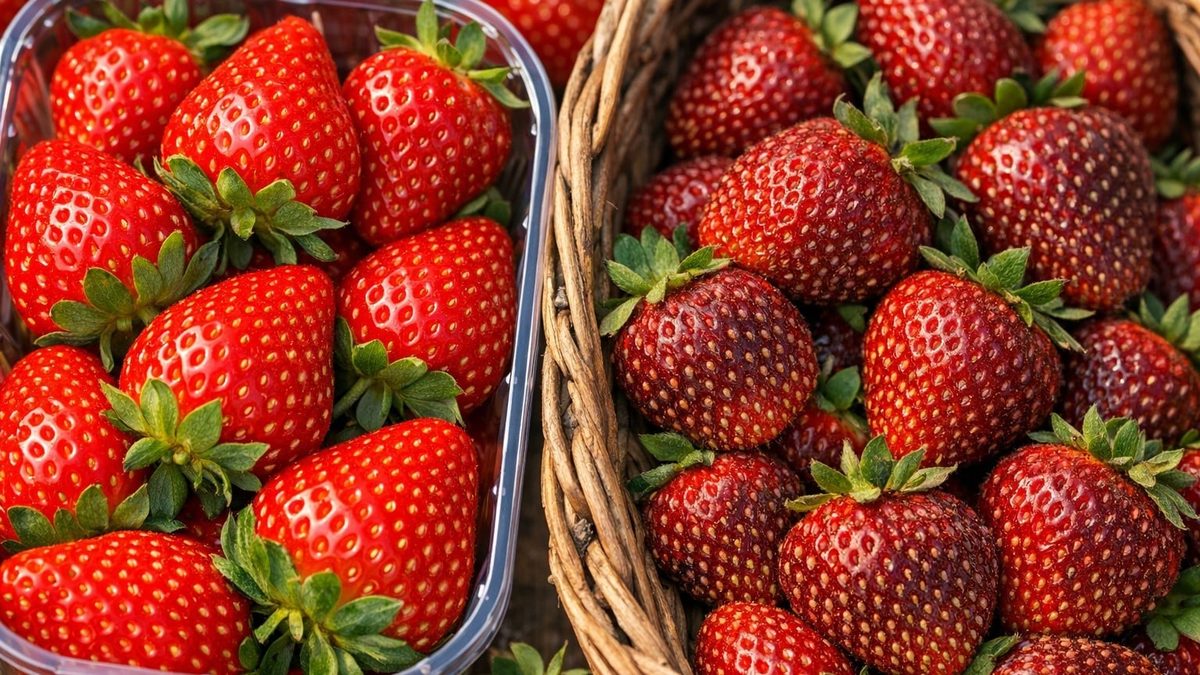
The sight of a plastic tray of bright red Spanish strawberries in the supermarket gondola is a spring ritual for millions. They are practical. They are cheap—often hovering around €2.99. They have been available since February. Even when the French harvest is bumper, supermarkets still import massive quantities from Spain.
But the labels don’t tell the whole story.
For years, independent analyses have revealed a darker side to these red fruits. They have become, almost unwillingly, symbols of an intensive agricultural model built on controversial methods. If you are trying to navigate which strawberries are safest to eat, the answer might surprise you.
The PFAS Problem in Spanish Imports
In 2024, a report by the UK’s Pesticide Residues in Food (PRiF) sent shockwaves through the industry. It exposed alarming levels of contamination in strawberries using substances classified as among the most persistent on Earth: PFAS. Scientists call them “forever pollutants” because they do not break down naturally.
These molecules have penetrated deep into the flesh of the fruit.
Rinsing won’t save you. The belief that washing strawberries removes these substances is an illusion. PFAS are embedded in the cellular structure.
The report identified strawberries from Spain’s Huelva province as the most contaminated. This region exports heavily across Europe. The data from the Générations Futures report in December 2025 is stark: 98% of cherries, 94% of grapes, and 93% of strawberries tested contained at least one detected residue.
Specifically for strawberries in 2025, 74% of non-organic samples contained at least one CMR substance (carcinogenic, mutagenic, or reprotoxic). Even more concerning, 54% contained PFAS.
That means more than half of the conventional strawberries in your basket carry a substance linked by scientists to hormonal disruption and chronic toxicity.
The conditions in which these Spanish strawberries are grown have also been flagged for ethical lapses. Reports cite the exploitation of migrant women, precarious working conditions, and the use of products banned in other EU countries. The intensive model, often involving plastic greenhouses, relies on chemical cocktails to meet high yield demands.
UFC-Que Choisir points out that these results reflect a lax regulatory framework. Current EU rules focus on maximum residue limits rather than ensuring the absence of risk, allowing potentially harmful substances—even at low doses—to remain legal in certain partner countries.
The French Alternative: A Different Quality Bar
French strawberry production for the 2025 campaign is estimated at around 71,500 tonnes, according to the Ministry of Agriculture. This follows a strong 2024 harvest of 77,200 tonnes, driven by favorable weather.
But the difference isn’t just geography.
French strawberries contain, on average, 60% fewer residues than their Spanish counterparts. The French Label Rouge certification takes this further. To earn this label, producers must adhere to a strict specification document covering 49 rigorous criteria.
Every batch undergoes more than 200 quality checks per season, including an annual sensory analysis. The result is a product that prioritizes safety and taste over sheer volume.
The main production basin is in the South-West, specifically Lot-et-Garonne, Dordogne, and Gironde. These departments produce about 22,700 tonnes. The region is famous for varieties like Gariguette, Ciflorette, and Charlotte.
Some producers also hold a Protected Geographical Indication (PGI). This guarantees origin and adherence to precise standards. For instance, certain lots in Lot-et-Garonne carry both PGI and Label Rouge status.
How to Find These Safer Options
The trade-off is accessibility. You won’t find these certified strawberries in the generic supermarket aisle. The Label Rouge and PGI systems create a direct bridge between producer and consumer, but it requires effort.
You need to seek them out.
- Visit local markets.
- Join AMAP schemes (farmers’ associations).
- Shop at short-circuit outlets.
For the 2025 high season, the Label Rouge sector reported a 20% increase in production compared to initial forecasts, driven by ideal conditions in Lot-et-Garonne. The supply is there. It just doesn’t come with the same shelf placement as the imported trays.
So, when you stand in front of that €2.99 tray next month, ask yourself what you are really buying. The price is clear. The origin is listed. But the chemical footprint? That requires digging deeper.
Why the cheapest strawberries might be the most expensive choice
It feels easy to point fingers at the shopper grabbing the discounted plastic tub from Spain. But that’s missing the real story. We are stuck in a trap. Inflation is biting hard. Wages aren’t keeping up. The equation is brutal: French strawberries simply cannot compete on price with their Andalusian counterparts.
Why? Because the rules are different.
In Spain, environmental and social standards are less strict. This lowers production costs. Those savings show up at the checkout. The French market is held hostage by this price gap.
We eat a lot of fruit. Annual consumption in France hits about 120,000 tonnes. That’s roughly 3 kg per household. But local farms only supply 50,000 tonnes. The rest? It crosses borders. It travels hundreds of kilometers. Sometimes it carries chemical residues along with it.
How to buy strawberries safely
You can lower your exposure to pesticides. It requires a few specific choices.
First, look for organic strawberries. Specifically, those labeled France origin. Buy them from short supply chains. This means farmers’ markets or local farm stands. Do it when they are in full season.
Here is the data that matters: organic strawberries, regardless of origin, showed no dangerous pesticide residues in recent studies. That is a hard fact. But there is a better window for French berries.
The sweet spot is between April and June. This is when open-field French production peaks. The quality-to-risk ratio is at its best. Outside this window, that generic “fraise” in the supermarket likely comes from far away. It brings back more than just taste.
The regulatory paradox
This isn’t just about bad actors. It’s about asymmetry. The European market operates on uneven rules.
Consider acetamiprid. This is a potent neonicotinoid. It was banned for French farmers in 2020. It’s a bee killer. Yet, it remains authorized in some EU partner countries. So, imported produce can contain it. French produce cannot.
We have a situation where:
* French farmers follow strict rules.
* They face rigorous traceability.
* They are undercut by products exempt from those same rules.
It is a paradox. A frustrating one. The industry tries to overcome it season after season. But until the playing field levels out, the consumer is left navigating a maze of regulations and prices.
The question remains: how long can local farmers survive when the rules favor lower standards? The answer isn’t clear. Not yet.